

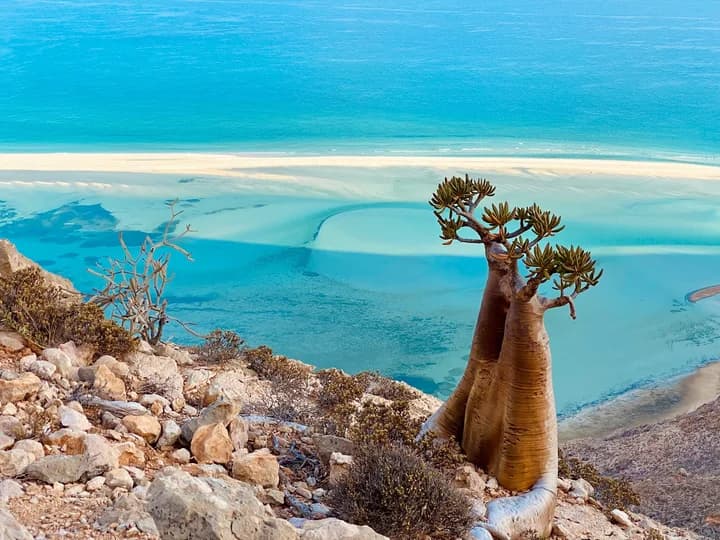
Detwah Lagoon
Detwah Lagoon: A Natural Paradise on Socotra Island
On the remote northwestern coast of Socotra Island, Yemen, lies one of the island's most impressive natural treasures: Detwah Lagoon. Located close to the coastal town of Qalansiyah, Detwah combines brilliant turquoise water, sweeping white sand, dramatic mountains, and an exceptionally rich marine ecosystem.
Although Socotra is famous around the world for its unusual landscapes and endemic plants, particularly the iconic Dragon's Blood Tree, Detwah Lagoon reveals another side of the island. Here, the beauty of Socotra is shaped by the meeting of land and sea.
A Wetland of International Importance
Detwah Lagoon is more than a beautiful beach. It is an ecologically important coastal wetland covering approximately 580 hectares.
In 2007, it became a designated Ramsar Site, recognizing the lagoon as a Wetland of International Importance. The wider Socotra Archipelago was later inscribed on the UNESCO World Heritage List in 2008 because of its exceptional biodiversity and high number of species found nowhere else on Earth.
The lagoon consists of several interconnected habitats, including shallow water, tidal and subtidal areas, sand dunes, seagrass beds, and surrounding terrestrial vegetation. These different environments allow an impressive variety of species to survive within a relatively small area.
A Landscape Shaped by Sea, Sand and Mountains
One of the first things visitors notice about Detwah Lagoon is its striking contrast of colors.
Pale sand stretches along the shoreline while shallow turquoise water gradually transitions into the deeper blue of the sea. Behind the lagoon rise limestone and granite cliffs reaching approximately 400 metres in height.
From elevated viewpoints around the lagoon, visitors can see its natural curves, tidal channels and sandbars spreading across the coastline.
At low tide, large areas of shallow water and exposed sand become visible. When the tide returns, the landscape changes again, creating an environment that is constantly being reshaped by the sea.
An Important Marine Habitat
Much of Detwah Lagoon's ecological importance lies beneath its surface.
Its relatively undisturbed seagrass habitats provide shelter and feeding grounds for marine organisms. Shallow waters are particularly valuable for juvenile fish because they can provide protection while the fish develop before moving toward deeper waters.
The lagoon is also notable for rays. Ramsar records identify Detwah as the only recorded location on Socotra for the Leopard Stingray and the Bluespotted Ribbontail Ray at the time of the site's ecological assessment.
Seagrasses, algae, crustaceans, gastropods and numerous fish species form part of the lagoon's interconnected ecosystem.
A Haven for Birds
Detwah is equally important above the water.
The wetland serves as a feeding and resting area for both resident and migratory waterbirds. Ramsar documentation records 32 bird species associated with the site, including resident breeding species and winter visitors.
Important species associated with the area include the Egyptian Vulture and the Socotra Cormorant, both of which contribute to the extraordinary bird diversity for which the Socotra Archipelago is known.
This combination of marine and bird life makes Detwah much more than a scenic destination. It functions as an important ecological refuge.
Part of Socotra's Extraordinary Biodiversity
Detwah Lagoon should also be understood within the wider environment of Socotra.
The Socotra Archipelago is one of the world's outstanding centres of biological endemism. UNESCO reports that approximately 37% of its plant species, 90% of its reptile species and 95% of its land-snail species occur nowhere else on Earth.
This extraordinary isolation is one reason Socotra is sometimes compared with other globally significant island ecosystems.
Detwah adds an important coastal and marine dimension to that biodiversity. While the island's mountains and forests protect distinctive terrestrial species, environments such as Detwah provide essential habitats for marine organisms and coastal birds.
A Place for Nature-Based Travel
For visitors, Detwah Lagoon offers an experience very different from a developed resort destination.
There are no large urban skylines surrounding the water. Instead, the main attraction is the landscape itself.
Walking along the shore, observing marine life in the shallows, watching birds, photographing the lagoon from higher ground and experiencing sunset over the coast can all form part of a visit.
Detwah has also long been associated with nature-based activities such as kayaking and exploring the coastline.
The relative simplicity of the experience is part of its appeal: visitors encounter a place where natural processes remain highly visible.
Why Conservation Matters
Detwah's beauty also makes it vulnerable.
Ramsar documentation identifies unregulated tourism and recreational activity as potential threats to the area. UNESCO has similarly highlighted the importance of sustainable tourism, effective management and protection of Socotra's sensitive ecosystems.
Protecting the lagoon therefore requires responsible behaviour from visitors and tourism operators.
Avoiding disturbance to wildlife, keeping waste out of the environment, respecting protected areas and supporting local communities can all help reduce the ecological impact of tourism.
The goal should not simply be to attract more visitors, but to ensure that future generations can experience Detwah in much the same natural condition.
Where Is Detwah Lagoon?
Detwah Lagoon is located on the northwestern part of Socotra Island, approximately 1.6 kilometres from Qalansiyah according to Ramsar documentation.
Final Thoughts
Detwah Lagoon represents much of what makes Socotra extraordinary.
It is visually beautiful, but its real importance goes deeper than its turquoise water and white sand. The lagoon is a functioning wetland ecosystem, a nursery for marine life, an important habitat for birds and part of one of the most biologically distinctive island environments on Earth.
For travellers, photographers, researchers and nature lovers, Detwah offers a rare opportunity to experience a landscape where desert-like mountains, coastal dunes, shallow seas and wildlife come together in one remarkable place.
More importantly, its status as a protected wetland reminds visitors that places of extraordinary beauty also carry extraordinary ecological value. Preserving Detwah Lagoon means protecting not only one of Socotra's finest landscapes, but also the complex web of life that depends on it.